Beliefs Traditions Types of Art and Lifestyle of a Group

The civilisation of Indonesia has been shaped past long interaction betwixt original indigenous customs and multiple foreign influences. Indonesia is centrally-located forth aboriginal trading routes between the Far East, Southern asia and the Middle Eastward, resulting in many cultural practices being strongly influenced by a multitude of religions, including Buddhism, Christianity, Confucianism, Hinduism, and Islam, all strong in the major trading cities. The result is a circuitous cultural mixture, often unlike from the original indigenous cultures.
Examples of the fusion of Islam with Hinduism include Javanese Abangan belief. Balinese dances have stories near ancient Buddhist and Hindu kingdoms, while Islamic fine art forms and compages are present in Sumatra, specially in the Minangkabau and Aceh regions. Traditional art, music and sport are combined in a martial art form called Pencak Silat.
The Western world has influenced Indonesia in scientific discipline, technology and modern entertainment such as telly shows, pic and music, likewise as political system and issues. India has notably influenced Indonesian songs and movies. A pop type of vocal is the Indian-rhythmical dangdut, which is often mixed with Arab and Malay folk music.
Despite the influences of foreign culture, some remote Indonesian regions even so preserve uniquely indigenous civilisation. Ethnic ethnic groups Mentawai, Asmat, Dani, Dayak, Toraja and many others are even so practising their ethnic rituals, customs and wearing traditional clothes.[1]
Traditional performing arts [edit]
Music [edit]

Indonesia is home to with those from the islands of Java, Sumatra and Bali being oftentimes recorded. The traditional music of West, Central, and Eastward Java and Bali is the gamelan (traditional instruments include: gambang, bonang, saron, kenong, gong, and many more). Gamelan is recognized as a Masterpiece of the Oral and Intangible Heritage of Humanity by UNESCO (United Nations Educational, Scientific and Cultural Organization).
On 29 June 1965, Koes Plus, a leading Indonesian pop group in the 1960s, 1970s and 1980s, was imprisoned in Glodok, Westward Jakarta, for playing Western-style music. After the resignation of President Sukarno, the law was rescinded, and in the 1970s the Glodok prison house was dismantled and replaced with a large shopping mall.
Kroncong is a musical genre that uses guitars and ukulele every bit the main musical instruments. This genre had its roots in Portugal and was introduced by Portuguese traders in the 15th century. There is a traditional Keroncong Tugu music grouping in North Jakarta and other traditional Keroncong music groups in Maluku, with strong Portuguese influences. This music genre was popular in the first half of the 20th century; a contemporary course of Kroncong is called Popular Kroncong.
Angklung musical orchestra, native of West Coffee, received international recognition as UNESCO has listed the traditional West Coffee musical instrument made from bamboo in the list of intangible cultural heritage.[2] [three]
The soft Sasando music from the province of East Nusa Tenggara in West Timor is completely different. Sasando uses an musical instrument made from a divide leaf of the Lontar palm (Borassus flabellifer), which bears some resemblance to a harp.
- Some examples of Indonesian traditional music instruments
Dance [edit]

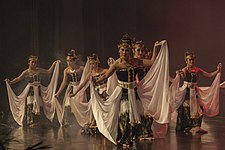
Indonesian dance reflects the diversity of culture from ethnic groups that composed the nation of Indonesia. Austronesian roots and Melanesian tribal dance forms are visible, and influences ranging from neighbouring Asian countries; such as Republic of india, China, and Heart Due east to European western styles through colonization. Each ethnic group has its own distinct dances; makes total dances in Indonesia are more 3000 Indonesian original dances. Still, the dances of Indonesia can exist divided into three eras; the Prehistoric Era, the Hindu/Buddhist Era, and the Era of Islam, and into 2 genres; court dance and folk dance.
There is a continuum in the traditional dances depicting episodes from the Ramayana and Mahabharata from Republic of india, ranging through Thailand, all the way to Bali. At that place is a marked difference, though, between the highly stylized dances of the courts of Yogyakarta and Surakarta and their popular variations. While the court dances are promoted and fifty-fifty performed internationally, the popular forms of dance art and drama must largely exist discovered locally.

Reog Ponorogo is also a dance that originated from the district Ponorogo, E Java, which is a visualization of the legendary story Wengker kingdom and the kingdom of Kediri.
A pop line dance chosen Poco-poco was originated in Indonesia and as well popular in Malaysia, but at early Apr 2011 Malaysian Islamic clerics banned the poco-poco dance for Muslims due to them assertive it is traditionally a Christian trip the light fantastic and that its steps make the sign of the cantankerous.[4]
During the Intergovernmental Committee for the Safeguarding of the Intangible Cultural Heritage convention in 29 November to 4 December 2015 in Windhoek, Namibia, UNESCO recognizes three genres of traditional dance in Bali, Indonesia, equally Intangible cultural heritage.[5] The three genres includes Wali (sacred dances), Bebali (semi-sacred dances) and Balih-balihan (dances for amusement purposes). Balinese trip the light fantastic has been proposed since 2011,[vi] and officially recognized in 2015.
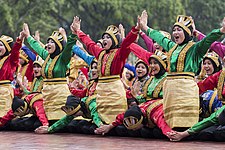
Previously, on 24 November, 2011, UNESCO officially recognized Aceh's traditional Saman dance as an Intangible Cultural Heritage in Demand of Urgent Safeguarding.[seven] [viii] [9]
- Some examples of Indonesian Traditional trip the light fantastic toe
-
-
Drama and theatre [edit]

The Wayang show, the Javanese, Sundanese, and Balinese shadow boob theatre shows display several mythological legends such every bit Ramayana, Mahabharata, and many more than. Wayang Orang is a Javanese traditional dance drama based on wayang stories. Various Balinese dance drama also can exist included inside the traditional grade of Indonesian drama. Another form of local drama is Javanese Ludruk and Ketoprak, Sundanese Sandiwara, and Betawi Lenong. All of these dramas incorporated humour and jest, often involving audiences in their performance.
The shadow puppets are by and large made of sheets of certain items. You lot tin can brand yours using wax newspaper and a sheet of translucent plastic, and download templates only those people actually do take the talent to craft their own and one-of-a-kind shadow puppets, which are carved one by i segment out of metallic or other special materials.[10] [11]
UNESCO designated Wayang the flat leather shadow puppet (wayang kulit) and the 3-dimensional wooden puppet (wayang golek or wayang klitik) theatre, as a Masterpiece of the Oral and Intangible Heritage of Humanity on 7 November 2003. In render for the acknowledgement, UNESCO required Indonesians to preserve the tradition.[12]
Randai is a folk theatre tradition of the Minangkabau people of W Sumatra, usually performed for traditional ceremonies and festivals. It incorporates music, singing, dance, drama and the silat martial art, with performances often based on semi-historical Minangkabau legends and love story.
Bangsawan is a Malay folk theatre found in the province of Riau.
Modern performing art besides developed in Indonesia with its distinct mode of drama. Notable theatre, trip the light fantastic toe, and drama troupe such as Teater Koma are gaining popularity in Indonesia as their drama often portray social and political satires of Indonesian guild.[13]
- Some examples of Indonesian Dance Drama and Theatre
-

Wayang Kulit (Leather shadow puppet) Functioning in Java
Martial arts [edit]
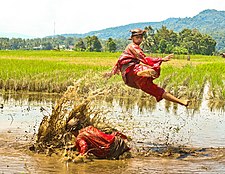
The art of Pencak Silat was created and firstly developed in the islands of Java and Sumatra.[14] It is an art for survival and practised throughout the Indonesian archipelago. Centuries of tribal wars in Indonesian history had shaped silat every bit information technology was used past the ancient warriors of Indonesia. Silat was used to decide the rank and position of warriors in one-time Indonesian kingdoms.
Pencak Silat is recognized equally a Masterpiece of the Oral and Intangible Heritage of Humanity past UNESCO (Un Educational, Scientific and Cultural Organization) on 12 December 2019.[15]
Contacts with Indians and Chinese has farther enriched silat. Silat reached areas across Indonesia mainly through the diaspora of Indonesian people. People from various regions similar Aceh, Minangkabau, Riau, Bugis, Makassar, Coffee, Banjar, etc. moved into and settled in Malay Peninsula and other islands. They brought silat and passed information technology down to their descendants. The Indonesian of half-Dutch descent are also credited as the first to have brought the art into Europe.
Silat was used by Indonesian independence fighters during their struggle against the Dutch colonial dominion. Unfortunately, after Republic of indonesia achieving their independence, silat became less popular amongst Indonesian youth compare to foreign martial arts like Karate and Taekwondo. This probably considering silat was not taught openly and merely passed down amid blood relatives, the other reason is the lack of media portrayal of the fine art.
Efforts have been fabricated to introduce and reintroduce the dazzler of silat to Indonesian youth and the world. Exhibitions and promotions by individuals as well every bit country-sponsored groups helped the growing of silat's popularity, particularly in Europe and United states. Indonesian 2009 Silat movie Merantau is one of Indonesian efforts to introduce silat to the international scene.
Another martial fine art from Indonesia is Tarung Derajat. It is a modernistic gainsay arrangement created past Haji Ahmad Drajat based on his experience as a street fighter. Tarung Drajat has been acknowledged equally a national sport past KONI in 1998 and is at present used by Indonesian Army as part of their basic training.[16]
In Eastern Indonesia, there is a type of martial art hitting with a whip or stick. Caci is a course of fighting with a whip or stick. It appears to be ethnic to Flores in East Nusa Tenggara, but it is also practised in Bali and Lombok.
- Some examples of Martial arts in Indonesia
Traditional visual arts [edit]
Painting [edit]
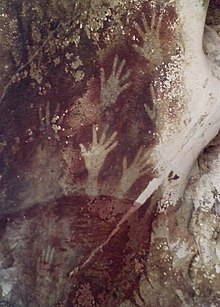
One of the oldest cave paintings in the world dating back more than 44,000 years erstwhile (fine art of the Upper Paleolithic), was plant in caves in caves in the district of Maros (Sulawesi, Indonesia). The oldest types of cave painting are hand stencils and elementary geometric shapes.[17]
In 2018, scientists reported the discovery of the then-oldest known figurative art painting, over 40,000 (perhaps equally former as 52,000) years erstwhile, of an unknown animal, in the cave of Lubang Jeriji Saléh on the Indonesian island of Kalimantan. In December 2019, however, figurative cavern paintings depicting pig hunting in the Maros-Pangkep karst in Sulawesi were estimated to be even older, at at least 43,900 years onetime. The finding was noted to be "the oldest pictorial record of storytelling and the earliest figurative artwork in the world".[18] [19]

Kamasan Palindon Painting detail, an example of Kamasan-style classical painting
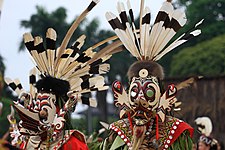
Indonesian painting before the 19th century is generally restricted to the decorative arts, considered to be a religious and spiritual activity, comparable to the pre-1400 European art. Artists' names are anonymous since the individual human creator was seen as far less important than their creation to honour the deities or spirits. Some examples are the Kenyah decorative art, based on endemic natural motifs such as ferns and hornbills, establish decorating the walls of Kenyah longhouses. Another notable traditional art is the geometric Toraja wood carvings. Balinese paintings are initially the narrative images to describe scenes of Balinese legends and religious scripts. The classical Balinese paintings are oftentimes decorating the lontar manuscripts and also the ceilings of temples pavilion.
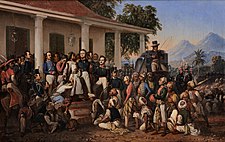
Under the influence of the Dutch colonial power, a trend toward Western-manner painting emerged in the 19th century. In the Netherlands, the term "Indonesian Painting" is applied to the paintings produced past Dutch or other foreign artists who lived and worked in the onetime Netherlands-Indies. The virtually famous ethnic 19th-century Indonesian painter is Raden Saleh (1807–1877), the first indigenous artist to study in Europe. His fine art is heavily influenced past Romanticism.[twenty] In the 1920s Walter Spies settled in Bali, he is ofttimes credited with alluring the attention of Western cultural figures to Balinese culture and art. His works have somehow influenced Balinese artists and painters. Today Bali has 1 of the well-nigh bright and richest painting traditions in Indonesia.
The 1920s to 1940s were a fourth dimension of growing nationalism in Republic of indonesia. The previous catamenia of the romanticism movement was not seen as a purely Indonesian movement and did not develop. Painters began to see the natural world for inspiration. Some examples of Indonesian painter during this period are the Balinese Ida Bagus Made and the realist Basuki Abdullah. The Indonesian Painters Association (Persatuan Ahli-Ahli Gambar Indonesia or PERSAGI, 1938–1942) was formed during this menses. PERSAGI established a contemporary art philosophy that saw artworks every bit reflections of the artist's private or personal view also as an expression of national cultural thoughts.[21] [22]
- Some examples of Indonesian painting
-
-
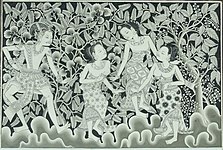
Modernistic painting of Prince Panji meeting three women in the jungle
Wood carvings [edit]

The fine art of forest carving is quite well-adult in Indonesia. Other than tribal art woodcarvings of Asmat, Batak, Dayak, Nias, and Toraja area is well known for its refined woods carving culture; they are Jepara in Fundamental Java and Bali. Mas village virtually Ubud in Bali is renowned for its wood etching fine art. Balinese woodcarving today has a sustained tourist market in Bali.
In Papua, asmat art consists of elaborate stylized woods carvings such every bit the bisj pole and is designed to honor ancestors. Many Asmat artefacts have been collected past the world's museums, among the most notable of which are those found in the Michael C. Rockefeller Drove at the Metropolitan Museum of Art in New York Metropolis and the Tropenmuseum in Amsterdam. Bisj poles are carved by Asmat religious carvers (wow-ipits) after a member of their tribe or community had been killed and headhunted past an enemy tribe. Carved out of a unmarried slice of a wild mangrove tree, Bisj poles can achieve heights of up to 25 feet (seven.62 m). Their carvings describe man figures standing on meridian of each other, too as animal figures, phallic symbols, and carvings in the shape of a canoe prow. The Asmat participated in headhunting raids and cannibalism as rituals, many rituals involved the Bisj poles, including dancing, masquerading, singing and headhunting—all performed by men.

The Nias adu zatua (wooden ancestor statues)
In Northward Sumatra, the people of Nias placed keen value on wooden figures or adu. The sole purpose of the Nias figures was to fulfil ritual needs, whether it is to ensure wealth or to perform specific beneficial rite. Niassan figures vary in size, from equally small as 20 centimetres (7.9 in) in height to more than two metres (6.half dozen ft) tall. When an elderly person died, the family would brand a wooden statue known every bit adu zatua. The statue was unveiled on the quaternary day after the death of the person. The shape of the wooden statue reflects the status of the person who used them: the more than powerful the owner, the more impressive the statue will be made. Nias people believed that the deceased person's spirits reside in the statue, then all events that occurred in the family were shared with the antecedent statues through prayers. Ancestor statues were placed in the master room of the firm, sometimes more than a hundred. A missionary piece of work in 1930 had recorded the removal of 'over 2000 "idols" from a house of new northern convert.' Some missionaries even recorded houses collapsing nether the weight of these antecedent figures. Small adu zatua were bound together horizontally using a rattan and pegs.
Many ancestor figures were destroyed in 1916 past Christian missionary movements which saw them as an old blasphemous religious symbol. Some were sold to collectors and tin be found in museum or private collections around the earth.
In Sulawesi, Torajans carve woods, calling it Pa'ssura (or "the writing"). One of the Toraja woods carvings is Tau tau, Tau tau is a kind of human statue made of wood or bamboo. Torajans believe that the dead can take their possessions with them to the afterlife, the effigies are commonly equipped with small possessions. Traditionally, the effigies were simply carved, merely to show the gender of the deceased. However, they have become more and more elaborate, really attempting to imitate the likeness of the deceased. Nowadays, Tau tau has a photographic likeness to the people they represent.
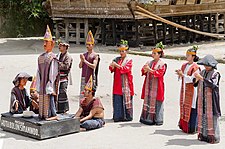
- Some examples of Indonesian wood carving for rituals
-
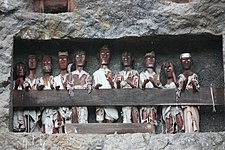
Toraja stone-carved burying site. Tau tau (wooden statue of the deceased) were put in the cave, looking out over the land, in Due south Sulawesi
-
-
Sculpture [edit]

Indonesia has a long history of stone, statuary and Iron Ages arts. Indonesia has a rich history of Hindu–Buddhist sculpture and architecture that has been shaped past a complex fusion of local, indigenous culture combined with foreign community. Some Indonesian artifacts made from gilded and bronze dating back to the 10th century are exhibited in the Usa.[23] The megalithic sculptures can be constitute in numerous archaeological sites in Sumatra, Java to Sulawesi. The native Indonesians tribes have their own distinct tribal sculpture styles, usually created to draw ancestors, deities and animals. The stone sculpture artform peculiarly flourished in 8th-to-10th-century Coffee and Bali, which demonstrate the influences of Hindu-Buddhist culture, both equally stand-alone works of art and also incorporated into temples. The virtually notable sculpture of the classical Hindu-Buddhist era of Republic of indonesia are the hundreds of meters of relief and hundreds of stone buddhas at the temple of Borobudur in central Java. Approximately ii miles of exquisite relief sculpture tell the story of the life of Buddha and illustrate his teachings. The temple was originally habitation to 504 statues of the seated Buddha. This site, as with others in key Java, prove a clear Indian influence.

The examples of notable Indonesian Hindu-Buddhist sculptures are; the statues of Hindu deities; Shiva, Vishnu, Brahma, Durga, Ganesha and Agastya enthroned in rooms of Prambanan temples, the Vishnu mounting Garuda statue of king Airlangga, the exquisite statue of Eastern Javanese Prajnaparamita and 3.seven meters tall Dvarapala dated from Singhasari period, and as well the chiliad statue of Bhairava Adityawarman discovered in Sumatra. Today, the Hindu-Buddhist manner stone sculptures are reproduced in villages in Muntilan virtually Borobudur also in Trowulan the former capital site of Majapahit in East Java, and Bali, and sold every bit a garden or pool ornamentation statues for homes, offices and hotels.
The walls of candi besides often displayed bas-reliefs, either serve equally decorative elements as well as to convey religious symbolic meanings; through describing narrative bas-reliefs. The about exquisite of the temple bas-reliefs can exist found in Hindu and Buddhist temples. The showtime four terraces of Borobudur walls are showcases for bas-relief sculptures. These are exquisite, considered to be the most elegant and graceful in the ancient Buddhist globe.[24] The Buddhist scriptures describes as bas-reliefs in Borobudur such as Karmavibhangga (the police of karma), Lalitavistara (the birth of Buddha), Jataka, Avadana and Gandavyuha. While in Prambanan the Hindu scriptures is describes in its bas-relief panels; the Ramayana and Bhagavata Purana (popularly known as Krishnayana).
The bas-reliefs in Borobudur depicted many scenes of daily life in eighth-century ancient Java, from the courtly palace life, hermit in the forest, to those of commoners in the village. It also depicted a temple, marketplace, various flora and fauna, and also native colloquial architecture. People depicted hither are the images of king, queen, princes, noblemen, courtier, soldier, retainer, commoners, priest and hermit. The reliefs also depicted mythical spiritual beings in Buddhist beliefs such equally asuras, gods, boddhisattvas, kinnaras, gandharvas and apsaras. The images depicted on bas-relief often served as a reference for historians to research certain subjects, such as the study of architecture, weaponry, economy, style, and too the way of transportation of 8th-century Maritime Southeast Asia. One of the famous renderings of an 8th-century Southeast Asian double outrigger ship is Borobudur Send.
- Some examples of Indonesian Statues and Reliefs
Architecture [edit]

For centuries, Indonesian colloquial compages has shaped settlements in Indonesia which commonly took the course of timber structures built on stilts dominated by a large roof. The near dominant foreign influences on Indonesian architecture were Indian, although European influences have been specially strong since the 19th century and modern architecture in Republic of indonesia is international in telescopic.

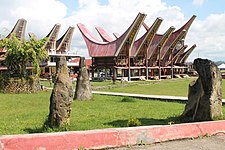
As in much of Southeast Asia, traditional vernacular architecture in Indonesia is built on stilts, with the significant exceptions of Java and Bali. Notable stilt houses are those of the Dayak people in Borneo, the Rumah Gadang of the Minangkabau people in western Sumatra, the Rumah Bolon of the Batak people in northern Sumatra, and the Tongkonan of the Toraja people in Sulawesi. Oversized saddle roofs with big eaves, such as the homes of the Batak and the tongkonan of Toraja, are often bigger than the house they shelter. The fronts of Torajan houses are frequently decorated with buffalo horns, stacked one above some other, every bit an indication of status. The outside walls also frequently feature decorative reliefs.
Candi is an Indonesian term to refer to ancient temples. Before the rise of Islam, betwixt the 5th to 15th-century Dharmic faiths (Hinduism and Buddhism) were the majority in the Indonesian archipelago, especially in Java and Sumatra. Every bit a upshot of numerous Hindu temples, locally known as candi, synthetic and dominated the landscape of Coffee. According to local beliefs, Java valley had thousands of Hindu temples that co-existed with Buddhist temples, most of which were buried in the massive eruption of Mount Merapi in 1006 Advertisement.

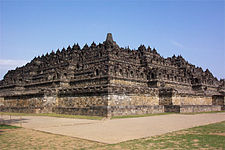
Between 1100 and 1500 additional Hindu temples were built, but abandoned by Hindus and Buddhists as Islam spread in Coffee circa the 15th to 16th century The 8th-century Borobudur temple near Yogyakarta is the largest Buddhist temple in the globe and is notable for incorporating well-nigh 2,672 relief panels and 504 Buddha statues into its structure, telling the story of the life of the Buddha. As the visitor ascends through the eight levels of the temple, the story unfolds, the final iii levels simply containing stupas and statues of the Buddha. The edifice is said to incorporate a map of the Buddhist cosmos and is a masterful fusion of didactic narrative relief, spiritual symbolism, awe-inspiring pattern and the serene meditative environs. The whole monument itself resembles a giant stupa, but seen from to a higher place it forms a mandala.[25]
The nearby ninth-century temple circuitous at Prambanan contains some of the best-preserved examples of Hindu temple architecture in Coffee. The temple complex comprises 8 main shrines, surrounded by 224 smaller shrines. The Indian influence on the site is clear, not only in the style of the monument, but too in the reliefs featuring scenes from the Ramayana which adorn the outer walls of the main temples, and in the votive statuary found inside. The bulk of Hindu temples in Java were dedicated to Shiva, who Javanese Hindus considered as the God who commands the free energy to destroy, recombine and recreate the cycle of life. Minor temples were often dedicated to Shiva and his family (married woman Durga, son Ganesha). Larger temple complexes include temples for Vishnu and Brahma, but the most imperial, sophisticated and central temple was dedicated to Shiva.
- Some examples of Architecture in Republic of indonesia
-

-
-
-
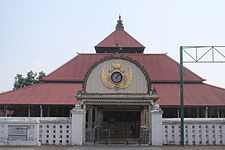
The Tajug or Meru type roof is ordinarily used on sacred buildings in Indonesia, especially Java
-

Crafts [edit]
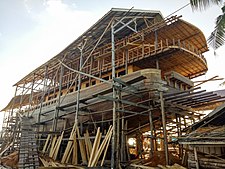
Indonesia is considered every bit dwelling house of world handicraft.[26] Every ethnic group has its own uniqueness, way, and philosophy of crafting.[26] Most of them are fabricated from wooden, bone, cloth, stone, and newspaper. These natural materials were crafted using hands into assisting and artful items.[26] Handicraft manufacturing serves not only as an important economic sector, just also a tradition and has a social function as well.[27] The handicraft industry employs thousands of people in towns and villages across the country. About half a billion dollar worth of handicraft is exported every yr, and many more is consumed domestically.[26] [27]
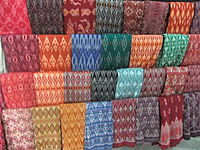
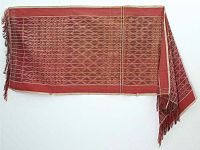
At that place are many varieties of handicraft from other regions.[26] West Sumatra and Due south Sumatra are particularly noted for their songket cloths.[28] Villages in the Bottom Sunda Islands produce ikat while provinces in Kalimantan are long known for their basketry and weaving using rattan and other natural fabrics.[29] Wood art produced by the Asmat people of Papua is highly valued.[30] Cities along Java's northern coast, Cirebon, Pekalongan, and Rembang are known as centres of batik.[31] Cirebon and Jepara are of import cities in piece of furniture, producing rattan and carved wood respectively,[32] while Tasikmalaya is known for embroidery.[33] Pasuruan also produces furniture and other products and support stores and galleries in Bali.[26] Bandung and Surabaya, both modern, cosmopolitan, and industrialised cities—much like Jakarta but on a bottom scale—are creative cities with a variety of innovative startups.[26]

A traditional tailor (Tenun) from Sumatra, in the process of sewing
Several Indonesian islands are famous for their batik, ikat and songket cloth. One time on the brink of disappearing, batik and afterward ikat, constitute a new lease on life when former President Suharto promoted wearing batik shirts on official occasions. In addition to the traditional patterns with their special meanings, used for item occasions, batik designs have become creative and diverse over the final few years.
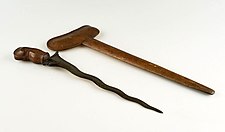
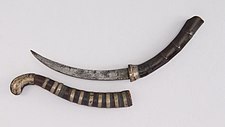
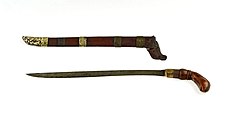
Other noted Indonesian crafts are Jepara wood etching[34] and Kris. In 2005, UNESCO recognised Kris equally one of Masterpiece of the Oral and Intangible Heritage of Humanity from Republic of indonesia.[35]
In 2012, Noken was listed in the UNESCO Intangible Cultural Heritage Lists every bit a cultural heritage of Republic of indonesia.[36] Women carrying noken are still a mutual sight in Wamena.[37]
Existence the all-time-known Indonesian sailing-vessel, Phinisi became the tagline for the 2017 inscription of ''The Art of Boatbuilding in South Sulawesi'' in the UNESCO's Representative List of the Intangible Cultural Heritage of Humanity.
- Some Indonesian Traditional Fabrics
-

-

-
-
- Some Indonesian Traditional Weapons
-
-

-
-
Clothing [edit]

Formal family unit portrait of former Indonesian'southward President B.J. Habibie. Women wear kain batik and kebaya with selendang (sash), while men clothing jas and dasi (western suit with necktie) with peci cap.
Indonesia's best-known national costumes are Batik and kebaya, although initially these costumes originated mainly from Javanese and Balinese civilization, which are most prominent in Javanese, Sundanese and Balinese cultures. Because Java has become the political center and population of Indonesia, the island'southward folk costume has been raised to national status. Equally a plural land, Indonesia has 34 provinces, each of which has representatives of traditional wearable from each province with unique and unlike designs. National costumes are worn at official occasions and traditional ceremonies. each province in Indonesia – more complete each group in Indonesia, has its own traditional costumes. The costumes of this surface area are in Indonesian chosen Pakaian tradisional or Pakaian adat, and are taken from traditional Indonesian fabric traditions and crafts.
National costumes [edit]
Batik [edit]

Batik is a textile that is traditionally made using a manual wax-resist dyeing technique to form intricate patterns. Traditionally batik cloth is a large piece of intricately decorated cloth used by Javanese women as kemben or torso wrap. Batik cloth was wrapped effectually the hips with multiple folds in front end called wiron, while the upper trunk wear kebaya fitted dress. Traditionally for men, the edge of batik cloth also can be sewn together to make a tubular cloth equally sarong, or wrapped around hips equally kain in a style similar to women'southward. Later for men, the batik cloth likewise is sewn and fabricated into contemporary batik men's shirt. Today, Batik shirts, which are normally worn past men in Indonesia (especially in Java), are normally worn during formal occasions; such as attending weddings, traditional ceremonies, formal meetings, communal gatherings, etc. Batik is recognized as one of the of import identity of Indonesian culture. UNESCO designated Indonesian batik every bit a Masterpiece of Oral and Intangible Heritage of Humanity on 2 October 2009.[38]
Kebaya [edit]
The kebaya is the national costume of women from Indonesia, although it is more than accurately endemic to the Javanese, Sundanese and Balinese peoples. It is sometimes made from sheer material such as silk, thin cotton or semi-transparent nylon or polyester, adorned with brocade or floral pattern embroidery. Kebaya ordinarily worn with a sarong or batik kain panjang, or other traditional woven garment such every bit ikat, songket with a colorful motif. Kebaya is commonly worn during official national events by Indonesian outset lady, wives of Indonesian diplomats, and Indonesian ladies. It too worn past Indonesian ladies attention traditional ceremonies and weddings. During Balinese traditional ceremonies, Balinese women wore colorful Balinese fashion kebaya with songket Bali.
Peci [edit]
The Peci, also known as songkok or kopiah, is a cap traditionally worn by male Muslims in the Indonesian archipelago. Information technology is quite similar to the Turkish-Egyptian fez. In Indonesia, the black velvet peci has become the national headdress with nationalist connotations made popular by Sukarno.[39] A number of Indonesian nationalist movement activists in the early 20th century, wore a peci to convey their nationalistic sentiments and to demonstrate their Indonesian identity. Indonesian male presidents ever habiliment a peci equally part of their official presidential attire. Since and so, the black velvet peci is approved to exist the national head-dress for Indonesian men. It is worn all over Indonesia, especially by government officials and men (usually Muslim men) throughout the land. The peci is unremarkably worn with a batik shirt or western-style suits past men in Indonesia for those attention formal occasions.
- Some traditional apparel in Republic of indonesia
-

Dayak traditional clothes
-

Osing traditional clothes
Foods [edit]

In 2011 an online poll by 35,000 people held by CNN International chose Rendang equally the number one dish of their 'Globe's 50 Virtually Delicious Foods' list.
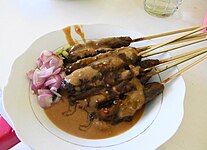
The cuisine of republic of indonesia has been influenced by Chinese civilization and Indian culture, likewise as past Western civilisation. However, in return, Indonesian cuisine has too contributed to the cuisines of neighbouring countries, notably Malaysia and Singapore, where Padang or Minangkabau cuisine from West Sumatra is very pop. Also, Satay (Sate in Indonesian), which originated from Coffee, Madura, and Sumatra, has gained popularity as a street vendor food from Singapore to Thailand. In the 15th century, both the Portuguese and Arab traders arrived in Indonesia with the intention of trading for pepper and other spices. During the colonial era, immigrants from many countries arrived in Republic of indonesia and brought unlike cultures as well as cuisines.
Most native Indonesians consume rice as the main dish, with a broad range of vegetables and meat as side dishes. However, in some parts of the land, such as Irian Jaya and Ambon, the bulk of the people eat sago (a type of tapioca) and sugariness white potato.
The most of import aspect of modern Indonesian cuisine is that nutrient must exist halal, conforming to Islamic nutrient laws. Haraam, the reverse of halal, includes pork and alcohol. Nevertheless, in some regions where there is a significant non-Muslim population, non-halal foods are also commonly served.

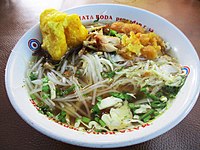
Indonesian dishes are usually spicy, using a wide range of chilli peppers and spices. The most popular dishes include nasi goreng (fried rice), Satay, Nasi Padang (a dish of Minangkabau) and soy-based dishes, such equally tofu and tempe. A unique characteristic of some Indonesian nutrient is the awarding of spicy peanut sauce in their dishes, as a dressing for Gado-gado or Karedok (Indonesian mode salad), or for seasoning grilled craven satay. Another unique attribute of Indonesian cuisine is using terasi or belacan, a pungent shrimp paste in dishes of sambal oelek (hot pungent chilli sauce). The sprinkling of fried shallots also gives a uniquely well-baked texture to some Indonesian dishes.
Chinese and Indian cultures have influenced the serving of nutrient and the types of spices used. It is very common to find Chinese food in Indonesia such as Dim Sum and noodles, and Indian cuisine such as Tandoori craven. In addition, Western culture has significantly contributed to the extensive range of dishes. Yet, the dishes have been transformed to suit Indonesian tastes. For example, steaks are usually served with rice. Popular fast foods such every bit Kentucky Fried Craven are served with rice instead of bread and sambal (spicy sauce) instead of ketchup. Some Indonesian foods have been adopted past the Dutch, similar Indonesian rice table or 'rijsttafel'.
- Some national dishes of Indonesia
-

-
-
-

Mythology and folklores [edit]

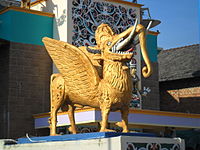
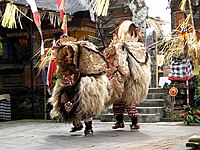
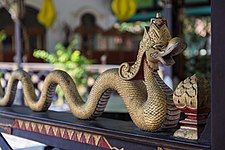
The mythology of Indonesia is very diverse, the Indonesian people consisting of hundreds of ethnic groups, each with their own myths and legends. The stories within this arrangement of lore often incorporate supernatural entities and magical creatures which form parts of Indonesian mythology. Others relate to creation myths and place naming legends that are often intertwined with historical figures and events. Aboriginal rituals for healing and traditional medicine likewise as circuitous philosophies regarding health and disease tin also be found.
These native mythologies are relatively free from foreign influences, such as Torajans, Nias, Bataks, Dayaks and Papuans. By contrast, Javanese, Balinese, and to some caste Sundanese were influenced by Hindu-Buddhist Indian mythology every bit early every bit the 1st century CE. Hindu gods, legends and epics such as Ramayana and Mahabharata were adopted and adapted into a uniquely local form.
Hindu-Buddhist mythical beings have a role in Javanese and Balinese mythology, including Hindu gods and heroes, devatas, asuras, apsaras (known as hapsari or bidadari), kinnaras, etc., while native gods of nature such as Semar, Dewi Sri, and Nyai Loro Kidul are either given identified as their Hindu counterpart or incorporated into a Coffee-Bali Hindu pantheon unknown in India. For example, native rice goddess Dewi Sri is identified with Lakshmi the shakti of Vishnu, and Semar and his sons the Punakawans are incorporated into the epic of Mahabharata in Javanese wayang kulit, as the clown servants of the Pandawas. Several names refer to gods, such equally Dewa (devas), Dewi (devi), dewata (devatas), and in native traditions usually referred to as Batara (male person god) and Batari (female person goddess).
After the coming of Islam to the Indonesian archipelago, Islamic mythology particularly those dealing with spiritual beings, such as devils, demons, jinns and angels entered Indonesian mythology. In Sumatra, Malay, Aceh and Minangkabau mythology was almost entirely supplanted by Islamic mythology. However, belief in local spirits such as the forest guardian, the ghost of water or haunted places all the same exists, often associated with a jinn or the tormented soul of a deceased human.
- Some mythological creatures in Indonesia
-

-
-
-
Literature [edit]

Early Indonesian literature originates in Malay literature, and the influence of these roots was felt until well into the twentieth century. The phrase "Indonesian literature" refers to Indonesian as written in the nation of Republic of indonesia, but also covers literature written in an earlier form of the linguistic communication, i.eastward. the Malay language written in the Dutch Due east Indies. Pramoedya Ananta Toer was Republic of indonesia'southward most internationally celebrated author, having won the Magsaysay Honor too as being considered for the Nobel Prize in Literature. Other important figures include the late Chairil Anwar, a poet and member of the "Generation 45" grouping of authors who were active in the Indonesian independence movement. Tight information controls during Suharto's presidency suppressed new writing, particularly because of its ability to agitate for social reform.
In the book Max Havelaar, Dutch author Multatuli criticised the Dutch treatment of the Indonesians, which gained him international attending.
Modern Indonesian authors include Seno Gumira Adjidarma, Andrea Hirata, Habiburrahman El Shirazy, Ayu Utami, Gus tf Sakai, Eka Kurniawan, Ratih Kumala, Dee, Oka Rusmini. Some of their works have translated to other languages.
Verse has a long tradition in Indonesia, particularly among ethnically Malay populations, of extemporary, interactive, oral composition of poetry. These poems are referred to as pantun. Contemporary Indonesian poets include among others, Sutardji Calzoum Bachri, Rendra, Taufiq Ismail, Afrizal Malna, Binhad Nurrohmat, Joko Pinurbo, Sapardi Djoko Damono. In written poetry and prose, a number of traditional forms dominate, mainly: syair (traditional narrative poetry), gurindam (cursory aphorisms), hikayat (stories, fairy-tales, creature fables, chronicles), babad (histories or chronicles).
On fifteen Dec 2020 the Pantun is recognized as a Masterpiece of the Oral and Intangible Heritage of Humanity by UNESCO (United Nations Educational, Scientific and Cultural Organization).
Recreation and sports [edit]
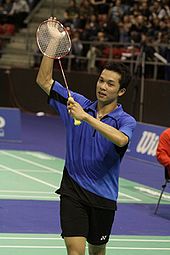
Taufik Hidayat, 2004 Olympic gilt medalist in badminton men'due south singles.
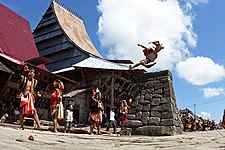
Many traditional games are still preserved and pop in Indonesia, although western civilization has influenced some parts of them. Amidst three hundred officially recognised Indonesian cultures, there are many kinds of traditional games: cockfighting in Bali, annual bull races in Madura, and stone jumping in Nias. Stone jumping involves leaping over a rock wall most upwardly to ane.v m high and was originally used to railroad train warriors. Pencak Silat is another popular course of sport, which was influenced past Asian civilization as a whole. Another grade of national sport is sepak takraw.[40] The rules are similar to volleyball: to continue the rattan ball in the air with the players' feet.
Popular modernistic sports in Indonesia played at the international level include football (soccer), badminton and basketball game.[41] Badminton is one of Indonesia'due south nearly successful sports. Indonesian badminton athletes have played in Indonesia Open Badminton Championship, All England Open Badminton Championships, and many international events, including the Summer Olympics and won Olympic gold medals since badminton was made an Olympic sport in 1992. Rudy Hartono is a legendary Indonesian badminton player, who won All England titles seven times in a row (1968 through 1974). Indonesian teams have won the Thomas Loving cup (men's world team championship) 13 of the twenty-2 times that it has been contested since they entered the serial in 1957.[42] In the internationally pop sport of football (soccer), Indonesian teams have been agile in the Asian Football Confederation (AFC).
Sporting events in Indonesia are organised past the Indonesian National Sports Commission (KONI). The committee, along with the regime of Indonesia, has set a National Sports Mean solar day every nine September with "Sports for All" as the motto. Indonesia has hosted the Southeast Asian Games 4 times, in 1979, 1987, 1997 and 2011, and won the overall champion championship in each of these years. As of 2011, Indonesia has won champion titles 10 times overall out of 18 Sea Games it has attended since debuted in 1977. The land likewise hosted the 1993 Asian Basketball Title.[43] Besides that, it has also hosted the Asian Games twice, the 1962 Asian Games and the 2018 Asian Games.
- Some Indonesian Traditional Sports
-
-

-

-

Popular media [edit]
Cinema [edit]
The largest chain of cinemas in Indonesia is 21 Cineplex, which has cinemas spread throughout twenty-4 cities on the major islands of Indonesia. Many smaller contained cinemas likewise exist.
In the 1980s, the film manufacture in Indonesia was at its tiptop, and dominated the cinemas in Indonesia with movies that accept retained a high reputation, such as Catatan Si Male child and Blok M and actors like Onky Alexander, Meriam Bellina, Nike Ardilla and Paramitha Rusady.[44] The flick Tjoet Nja' Dhien (1988) winning 9 Citra Awards at the 1988 Indonesian Pic Festival.[45] [ full commendation needed ] It was besides the starting time Indonesian movie chosen for screening at the Cannes Film Festival,[45] [ full commendation needed ] where information technology was awarded Best International Film in 1989.[46] [ full citation needed ] Withal, the movie industry failed to continue its successes in the 1990s, when the number of movies produced decreased significantly, from 115 movies in 1990 to simply 37 in 1993.[47] As a result, almost movies produced in the 1990s contained developed themes. The industry started to recover in the late 1990s, with the rise of independent directors and many new movies produced, such as Garin Nugroho'south Cinta dalam Sepotong Roti, Riri Riza and Mira Lesmana's Petualangan Sherina and Arisan! by Nia Dinata.[44] Another class of recovery is the re-establishment of the Indonesian Movie Festival (FFI), inactive for twelve years, and the cosmos of the Jakarta International Picture show Festival. Daun di Atas Bantal (1998) received Asia Pacific Moving picture Festival in Taipei.[48]
Goggle box [edit]
Radio [edit]
The state radio network Radio Republik Indonesia (RRI) was founded in 1945. Information technology consists of a network of regional stations located in all thirty-iii provinces of the archipelago. In most cities and large towns there are likewise many commercial stations. Since 2006, several digital radio stations have been based in Jakarta and Surabaya, using Digital Audio Broadcasting (DAB) and Hybrid HD-Radio.[49] [50] [51]
Organized religion and philosophy [edit]
Islam is Indonesia'due south main religion, with most 88% of Indonesians declared Muslim according to the 2000 census,[52] making Indonesia the virtually populous Muslim-bulk nation in the globe. The remaining population is 9% Christian (of which roughly two-thirds are Protestant with the remainder mainly Catholic, and a big minority Charismatic), ii% Hindu, and 1% Buddhist.
The Pancasila, the statement of ii principles that encapsulate the ideology of the Indonesian state, affirms that "The country shall be based on the belief in the 1 and but God".
- Some Indonesian ritual worship
-

Maudu Lompoa tradition in Sulawesi, to commemorate the altogether of the prophet Muhammad
-

Labuhan procession in Yogyakarta is believed to help preserve the rest of nature
Celebrations [edit]
| Date (Gregorian Calendar) | Date (Religious Calendar) | English language Name | Local Name | Remarks |
|---|---|---|---|---|
| 1 January | New Year'south Twenty-four hour period | Tahun Baru Masehi | ||
| Rabi' al-awwal 12 | Nativity of the Prophet | Maulid Nabi Muhammad | Birthday of the Islamic Prophet Muhammad | |
| Jan–February | Chinese New year's day | Tahun Baru Imlek | 1st solar day of 1st month of Chinese Calendar | |
| March | Kasa one Pawukon twoscore | Twenty-four hours of Silence | Hari Raya Nyepi (Tahun Baru Saka) | New year's day of Balinese calendar |
| March–April | Good Friday | Wafat Yesus Kristus/Isa Almasih (Jumat Agung) | Date varies; this is the Friday before Easter Sunday, which is the kickoff Sun after the commencement Paschal Full Moon following the official vernal equinox | |
| 1 May | Labour Twenty-four hour period | Hari Buruh | ||
| May–June | Ascension of Jesus Christ | Kenaikan Yesus Kristus/Isa Almasih | ||
| May | Every May of Vaisakha | Buddha'south Altogether | Waisak | In Indonesia it is celebrated as Trisuci Waisak, to commemorate iii of import events in Buddhism; Buddha's birthday, enlightenment and his decease. The date varies according to the Buddhist calendar |
| Rajab 27 | Rise of the Prophet | Isra Mi'raj Nabi Muhammad | ||
| 1 June | Pancasila Solar day | Hari Lahir Pancasila | Public vacation since 2016, marks the appointment of Sukarno'south 1945 address on the national ideology | |
| 17 August | Independence 24-hour interval | Hari Proklamasi Kemerdekaan R.I. | Sukarno and Mohammad Hatta as the proclaimers | |
| Shawwal 1–ii | Twenty-four hours subsequently Ramadan | Idul Fitri (Lebaran Mudik) | Engagement varies co-ordinate to the Islamic calendar | |
| Dhu al-Hijjah 10 | Feast of the Sacrifice | Idul Adha (Lebaran Haji) | Date varies co-ordinate to the Islamic calendar | |
| Muharram 1 | Islamic New year's day | Tahun Baru Hijriyah | 1st day of the Muharram, the showtime of the new Islamic year | |
| 25 December | Christmas | Hari Natal |
See likewise [edit]
- Demographics of Indonesia
- List of museums and cultural institutions in Indonesia
- National Intangible Cultural Heritage of Republic of indonesia
References [edit]
- ^ Taylor, Jean Gelman (2003). Republic of indonesia peoples and Histories. ISBN0-300-10518-5.
- ^ "Indonesian Angklung". Unesco.org . Retrieved 21 August 2017.
- ^ "UNESCO grants Republic of indonesia's angklung cultural heritage championship". News.xinhuanet.com. Archived from the original on 8 July 2013. Retrieved 21 August 2017.
- ^ "Archived copy". Archived from the original on 4 April 2011. Retrieved iv Apr 2011.
{{cite web}}: CS1 maint: archived copy as title (link) - ^ "Traditional dances, crafts, noesis and music on the agenda at Intangible Heritage Committee meeting in Namibia". UNESCO . Retrieved 1 December 2015.
- ^ "Traditional dances proposed to exist world'south heritage". The Jakarta Post. 16 November 2011. Retrieved 1 December 2015.
- ^ ""Saman dance", Inscribed in 2011 (vi.COM) on the Listing of Intangible Cultural Heritage in Demand of Urgent Safeguarding List". UNESCO. Retrieved x October 2014.
- ^ "UNESCO officially recognizes Saman Dance as part of intangible cultural heritage, UNESCO". 24 November 2011. Archived from the original on 27 November 2011.
- ^ "nine Properti Tari Saman (Lengkap beserta gambar dan deskripsi)".
- ^ Ness, Edward C. Van; Prawirohardjo, Shita (1980). Javanese Wayang Kulit: An Introduction. Oxford Academy Printing. ISBN9780195804140.
- ^ Miyao, J. (1977). "P. L. Amin Sweeney and Akira Goto (ed.) An International Seminar on the Shadow Plays of Asia". Southeast Asia: History and Culture. Nihon Society for Southeast Asian Studies (7): 142–146. doi:10.5512/ocean.1977.142.
- ^ ""Wayang puppet theatre", Inscribed in 2008 (three.COM) on the Representative List of the Intangible Cultural Heritage of Humanity (originally proclaimed in 2003)". UNESCO. Retrieved x October 2014.
- ^ Yves Bonnefoy (1993). Asian Mythologies. University of Chicago Press. p. 162. ISBN978-0-226-06456-7.
- ^ Donn F. Draeger (1992). Weapons and fighting arts of Indonesia. Rutland, Vt. : Charles East. Tuttle Co. ISBN978-0-8048-1716-5.
- ^ "'Pencak silat' given UNESCO intangible globe heritage stardom". The Jakarta Post . Retrieved 13 December 2019.
- ^ Donn F. Draeger (1992). Weapons and fighting arts of Republic of indonesia. Rutland, Vt. : Charles E. Tuttle Co. ISBN978-0-8048-1716-five.
- ^ K. Aubert et al., "Pleistocene cave art from Sulawesi, Indonesia", Nature volume 514, pages 223–227 (9 Oct 2014). "using uranium-series dating of coralloid speleothems directly associated with 12 human manus stencils and two figurative animal depictions from vii cave sites in the Maros karsts of Sulawesi, we show that rock art traditions on this Indonesian isle are at least compatible in historic period with the oldest European art. The earliest dated image from Maros, with a minimum age of 39.nine kyr, is at present the oldest known hand stencil in the world. In addition, a painting of a babirusa ('pig deer) made at least 35.4 kyr ago is among the earliest dated figurative depictions worldwide, if not the earliest i. Among the implications, it can at present be demonstrated that humans were producing rock art by ~40 kyr ago at reverse ends of the Pleistocene Eurasian world."
- ^ Aubert, 1000.; et al. (11 Dec 2019). "Earliest hunting scene in prehistoric art". Nature. 576 (7787): 442–445. doi:10.1038/s41586-019-1806-y. PMID 31827284. S2CID 209311825.
- ^ Ferreira, Becky (11 Dec 2019). "Mythical Beings May Be Earliest Imaginative Cave Fine art by Humans - The paintings on an Indonesian isle are at least 43,900 years old and describe humanoid figures with animal-like features in a hunting scene". The New York Times . Retrieved 12 December 2019.
- ^ Hilda Soemantri, ed. Indonesian Heritage: Visual Art. Singapore: Didier Millet, 1998: p. 45-49.
- ^ Hilda Soemantri, ed. Indonesian Heritage: Visual Art. Singapore: Didier Millet, 1998: p. 50-59
- ^ Astri Wright, Soul, Spirit and Mountain, Preoccupations of Contemporary Indonesian Painters, Oxford University Press, 1994.
- ^ Reif, Rita (5 August 1990). "ANTIQUES; Statuary Treasures From Indonesia". The New York Times. ISSN 0362-4331. Retrieved fifteen November 2021.
- ^ Cockrem, Tom (18 May 2008). "Temple of enlightenment". The Sydney Morning Herald . Retrieved 11 November 2011 – via The Buddhist Channel.tv.
- ^ "Borobudur : A Wonder of Indonesian History". Indonesia Travel. Archived from the original on fourteen April 2012. Retrieved v Apr 2012.
- ^ a b c d e f g "Indonesia'south Remarkable Handicraft" (PDF). Indonesian Ministry of Trade. February 2016. Archived (PDF) from the original on 10 Oct 2017. Retrieved 10 Oct 2017.
- ^ a b Barber, Ted; Krivoshlykova, Marina (July 2016). "Global Market Assessments of Handicrafts" (PDF). USAID. Archived (PDF) from the original on 27 December 2016. Retrieved 27 December 2016.
- ^ Sanday, Peggy R.; Kartiwa, Suwati (August 1984). "Cloth and Custom in West Sumatra: The Codification of Minangkabau Worldview". Penn Museum. Archived from the original on 21 December 2016. Retrieved 21 Dec 2016.
- ^ "Indonesian Endless-Basket Inventiveness" (PDF). Indonesian Ministry of Merchandise. 8 December 2012. Archived (PDF) from the original on 10 October 2017. Retrieved 10 Oct 2017.
- ^ Andersen, Øystein L. (March 2006). "Babrongko, Fabric culture of a Lake Sentani Village" (PDF). Cenderawashi University. Archived (PDF) from the original on 10 October 2017. Retrieved 10 October 2017.
- ^ Situngkir, Hokky (August 2009). "The Phylomemetics of Batik" (PDF). Archived (PDF) from the original on x May 2017. Retrieved 10 May 2017.
- ^ Puntodewo, Atie; Melati; Achdiawan, Ramadhani; Irawati, Rika Harini; Purnomo, Herry. "Jepara Furniture: Tourist map and shopping guide" (PDF). Archived (PDF) from the original on x October 2017. Retrieved x October 2017.
- ^ "Indonesian Embroidery: The Elegant Motifs" (PDF). Indonesian Ministry of Merchandise. 8 December 2012. Archived (PDF) from the original on 27 December 2016. Retrieved 27 December 2016.
- ^ "High Quality Jepara Woodcarving". ane Nov 2010. Archived from the original on i November 2010. Retrieved 21 August 2017.
{{cite web}}: CS1 maint: bot: original URL status unknown (link) - ^ "Intangible Heritage Home – intangible heritage – Culture Sector – UNESCO". Unesco.org . Retrieved 21 Baronial 2017.
- ^ ""Noken multifunctional knotted or woven pocketbook, handcraft of the people of Papua", Inscribed in 2012 (7.COM) on the List of Intangible Cultural Heritage in Demand of Urgent Safeguarding". UNESCO. Retrieved 10 Oct 2014.
- ^ Nethy Dharma Somba (26 September 2011). "Transforming Wamena into Papua's tourism icon". The Jakarta Post. Archived from the original on 10 May 2013. Retrieved xv March 2013.
- ^ Indonesian Batik Inscribed in 2009 on the Representative List of the Intangible Cultural Heritage of Humanity
- ^ Yusep Hendarsyah (28 April 2011). "Peci Hitam dan Identitas Paling Republic of indonesia". Kompasiana. Archived from the original on 12 August 2012. Retrieved 28 March 2012.
- ^ "Gajah Emas Game History – Sepak Raga Archived 24 November 2007 at the Wayback Automobile"
- ^ "94Fifty Announces Distribution Partner for Indonesia – Exclusive benefactor of 94Fifty Basketball skill technology named for growing basketball market. Archived 21 Dec 2011 at the Wayback Machine"
- ^ U.k. on-line: sport Archived 2 December 2008 at the Wayback Machine
- ^ "FIBA Asia Competition Archives". Competition Archives. International Basketball Federation FIBA. 26 September 2011. Retrieved xv April 2012.
- ^ a b Kompas "Archived re-create". Archived from the original on 13 January 2008. Retrieved 31 Oct 2016.
{{cite web}}: CS1 maint: archived copy as championship (link) - ^ a b Monash 2007-08-03, Tjoet Nja' Dhien. sfn error: no target: CITEREFMonash_2007-08-03,_Tjoet_Nja'_Dhien (help)
- ^ Siapno 2006, p. 25. sfn error: no target: CITEREFSiapno2006 (help)
- ^ "Kondisi Perfilman di Indonesia". Webcitation.org. Archived from the original on 23 Oct 2009. Retrieved 21 August 2017.
- ^ "Asia-Pacific Motion picture Festival". IMDb.com . Retrieved 21 Baronial 2017.
- ^ "Archived re-create". Archived from the original on 26 June 2010. Retrieved fifteen September 2010.
{{cite spider web}}: CS1 maint: archived re-create as title (link) - ^ "Archived copy". Archived from the original on 15 July 2011. Retrieved fifteen September 2010.
{{cite web}}: CS1 maint: archived copy as title (link) - ^ "Archived copy". Archived from the original on eleven March 2016. Retrieved 15 September 2010.
{{cite web}}: CS1 maint: archived copy as title (link) - ^ "The World Factbook – Fundamental Intelligence Agency". Cia.gov . Retrieved 21 August 2017.
Further reading [edit]
- Kuncaraningrat. (1985) Javanese civilisation Singapore: Oxford Academy Press,
- Kathleen Chiliad. Adams (2006). Art as Politics: Re-crafting Identities, Tourism and Power in Tana Toraja, Indonesia. Honolulu: University of Hawaii Printing. ISBN978-0-8248-3072-4.
Source: https://en.wikipedia.org/wiki/Culture_of_Indonesia
0 Response to "Beliefs Traditions Types of Art and Lifestyle of a Group"
Post a Comment