Yes We Can We See Eachother Again in Spanish
Learning to say "aye" is usually one of the beginning things you learn when studying a new linguistic communication. Unfortunately, yous might be surprised to learn that in Chinese, in that location's no directly equivalent to the English language "aye." Fright non! We're here to walk you through some of the most common ways to say "yep" in Chinese. For example, 是 (🔈 shì)!

Table of Contents
- No Direct Translation
- 10 Common Ways to Say "Yes" in Chinese
- 1. 是 | shì | to exist; yes
- 2. 对 | duì | correct
- 3. 没错 | méicuò | not wrong
- 4. 好 | hǎo | good
- five. 可以 | kěyǐ | can; may; [indicating permission]
- 6. 行 | xíng | ok; alright
- 7. 嗯 | èn | yep
- 8. 没问题 | méiwèntí | no problem
- 9. 当然 | dāngrán | of course
- x. "Yes" in other situations
- Just say "yeah!"
- Essential Vocabulary for Proverb Yes in Chinese
No Directly Translation
Mandarin has no direct translation for the English word "yes," so saying "yes" in Chinese can get a bit complicated. The only way to limited the affirmative in Chinese is to consider the context in which you want to utilise it.
If that sounds scary, don't worry. It's actually much more than similar to English language than you might think. While "yeah" is generally the go-to affirmative answer for English language speakers, we as well accept a lot of other affirmative words and phrases that we use in various different situations. For example, "certain," "OK," "of course," "yep," "that's right," "correct" and "no problem" can also be used to mean "yep" depending on the context.
Merely like in English, the more ways y'all know to express the affirmative in Chinese, the more like a native speaker yous'll sound. Check out our list of 10 common means to say "yes" in Chinese beneath.

10 Common Ways to Say "Yes" in Chinese
1. 是 | shì | to exist; yes
Ane style to say "yep" in Chinese is 是, or shì in pinyin . It's normally used to confirm that something is truthful, in the aforementioned mode that we might say "yes, I am" or "yeah, information technology is" in response to a respective question in English.
Check out these examples to get a ameliorate idea of how this works:
| Speaker | 汉字 | Pinyin | English language |
|---|---|---|---|
| A: | 你是美国人吗? | Nǐ shì Měiguórén ma? | Are yous American? |
| B: | 是。 | Shì. | Yes, I am. |
| Speaker | 汉字 | Pinyin | English language |
|---|---|---|---|
| A: | 你是不是学生? | Nǐ shìbùshì xuéshēng? | Are you a student? |
| B: | 是。 | Shì. | Yep, I am. |
Notation that when you answer to a question using 是 (shì), the question that was asked will normally also contain 是 (shì), which in sure contexts is the crude equivalent of the English language verb "to be."
| Speaker | 汉字 | Pinyin | English language |
|---|---|---|---|
| A: | 这是你的背包吗? | Zhè shì nǐ de bèibāo ma? | Is this your backpack? |
| B: | 是。 | Shì. | Yes, it is. |

Learning to say "yes" in Chinese is an important skill that all students of Mandarin demand to chief.
Note that because answering a question that includes 是 (shì) often involves repeating the verb used in the question, this apply of 是 (shì) can besides be explained using the pattern discussed in section 10 (yeah in other situations) below.
是的 (shìde) is a common variation of 是 (shì) which sounds more formal and polite than 是 (shì) by itself. It is a common fashion to say "yes" in piece of work environments when a subordinate wants to reply in the affirmative to a managing director, boss, or other person in a more senior position.
For example:
| Speaker | 汉字 | Pinyin | English language |
|---|---|---|---|
| A: | 你这周是不是要出差? | Nǐ zhè zhōu shìbùshì yào chūchāi? | Are you going on a business organization trip this week? |
| B: | 是的。 | Shìde. | Yes, that's right. |
two. 对 | duì | correct
对 (duì), which means "right" or "correct," is another mutual way to say "yep" in Chinese. It's very similar to 是 (shì), and in many cases the 2 can exist used interchangeably.
In general, if a question contains 对 (duì), the response is more than likely to exist 对 (duì), while if the question contains 是 (shì), the response is probable to exist 是 (shì).
For example:
| Speaker | 汉字 | Pinyin | English language |
|---|---|---|---|
| A: | 这是你的手机,对吗? | Zhè shì nǐ de shǒujī, duì ma? | This is your cell phone, right? |
| B: | 对。 | Duì. | Yeah, that's right. |
对 (duì) is as well often used to express agreement with a argument that someone else has made, as in the post-obit example:
| Speaker | 汉字 | Pinyin | English |
|---|---|---|---|
| A: | 我觉得这朵花很漂亮。 | Wǒ juédé zhè duǒ huā hěn piàoliang. | I think this blossom is really cute. |
| B: | 对。 | Duì. | Yeah, I think so too. |
three. 没错 | méicuò | not wrong
The expression 没错 (méicuò) is another way to say "yeah" in Chinese. It's similar to 对 (duì) in that it'due south ofttimes used to agree with a statement that someone else has made.
If we suspension 没错 (méicuò) into its component parts, we can see that 没 (méi) means "no" or "not," as in 没有 (méiyǒu, non have; be without), while 错 (cuò) ways "wrong" or "fault," equally in 错误 (cuòwù, mistake; error). Thus, 没错 (méicuò) literally means "not incorrect."
没错 (méicuò) is often used when agreeing with someone else'due south opinion and is the equivalent of English phrases like "that'due south truthful" or "that'south right."
For example:
| Speaker | 汉字 | Pinyin | English |
|---|---|---|---|
| A: | 四川人很会吃辣。 | Sìchuānrén hěn huì chī là. | People from Sichuan actually love spicy food. |
| B: | 没错。 | Méicuò. | Yes, that's right. |

Context is disquisitional when deciding which version of "aye" to use in Chinese.
4. 好 | hǎo | expert
好 (hǎo) is another way to say "aye" in Chinese. The about basic meaning of 好 (hǎo) is "skilful." You probably recognize this character from 你好 (nǐhǎo, hi), which is usually one of the get-go words that beginning Chinese students larn.
In Chinese, 好 (hǎo) can exist used as the crude equivalent of "good," "fine" or "OK" in English.
For instance:
| Speaker | 汉字 | Pinyin | English |
|---|---|---|---|
| A: | 我们现在去散步。 | Wǒmen xiànzài qù sànbù. | We're going for a walk now. |
| B: | 好。 | Hǎo. | OK, sounds good. |
In addition to using 好 (hǎo) by itself, it'due south also possible to modify the significant of your response slightly past adding various particles to the end.
For case, adding the particle 的 (de) creates 好的 (hǎo de), which can be translated as "OK" or "will practice." Information technology's oftentimes (although non exclusively) used past people in the service industry when like-minded with a customer'due south request.
For example:
| Speaker | 汉字 | Pinyin | English |
|---|---|---|---|
| A: | 师傅,你八点来接我,好吗? | Shīfù, nǐ bā diǎn lái jiē wǒ, hǎo ma? | Driver, could you option me upwardly at viii o'clock? |
| B: | 好的。 | Hǎo de. | Sure, will exercise. |
Also, if you add together the particle 呀 (ya) to 好 (hǎo), you get 好呀 (hǎo ya), which makes you sound excited most any fun plan or action the person you're talking to has proposed.
For example:
| Speaker | 汉字 | Pinyin | English |
|---|---|---|---|
| A: | 我们明天一起去看电影吧。 | Wǒmen míngtiān yīqǐ qù kàn diànyǐng ba. | Let'south go see a pic tomorrow. |
| B: | 好呀! | Hǎo ya! | OK! |

Learning how to say "yeah" in a variety of ways will make your Chinese sound more accurate.
In contrast to 好呀 (hǎo ya), answering someone using 好 (hǎo) plus the particle 吧 (ba), or 好吧 (hǎo ba), makes you audio as if you lot're less than pleased well-nigh any it is that the person yous're talking to is proposing.
好吧 (hǎo ba) is still a style to agree with someone's suggestion, merely it'due south a reluctant class of agreement that indicates you'd rather not do whatever information technology is that's been proposed.
For example:
| Speaker | 汉字 | Pinyin | English language |
|---|---|---|---|
| A: | 你早上五点来我家,好吗? | Nǐ zǎoshang wǔ diǎn lái wǒ jiā, hǎo ma? | Come up by my business firm at 5am, OK? |
| B: | 好吧。 | Hǎo ba. | OK. |
Final simply not least, if you add the particle 了 (le), you get 好了 (hǎo le). This phrase can be used to respond affirmatively to certain questions. When used in this way, it has positive connotations and is like to "yes" in English.
For example:
| Speaker | 汉字 | Pinyin | English |
|---|---|---|---|
| A: | 你准备好了吗? | Nǐ zhǔnbèi hǎo le ma? | Are y'all ready? |
| B: | 好了! | Hǎo le! | Yep, I'm ready! |
In certain contexts, the phrase 好了 (hǎo le) can also have negative connotations, however. This is normally the instance when it's being used to respond to someone who is pushing you to exercise something or finish something more quickly or efficiently. In this case, it'southward similar to "OK, OK" in English and using it makes you sound a fleck exasperated.
| Speaker | 汉字 | Pinyin | English |
|---|---|---|---|
| A: | 你还没准备好吗? | Nǐ hái méi zhǔnbèi hǎo ma? | Yous're still non ready? |
| B: | 好了,好了,我已经好了。 | Hǎo le, hǎo le, wǒ yǐjīng hǎo le. | OK, OK, I'k gear up now. |
5. 可以 | kěyǐ | tin; may; [indicating permission]
The phrase 可以 (kěyǐ) is some other style to limited the affirmative in Chinese. Information technology'south often used when asking for or giving permission to do something. In this context, its pregnant is similar to "can" or "may." Every bit a response, it can exist roughly translated every bit "sure," "OK," or "yes, y'all tin."
Notation that if the question contains 可以 (kěyǐ), information technology's likely that the response will as well.
For example:
| Speaker | 汉字 | Pinyin | English |
|---|---|---|---|
| A: | 我可以借你的笔吗? | Wǒ kěyǐ jiè nǐ de bǐ ma? | Can I infringe your pen? |
| B: | 可以。 | Kěyǐ. | Sure yous can. |
Another instance:
| Speaker | 汉字 | Pinyin | English language |
|---|---|---|---|
| A: | 这里可以拍照吗? | Zhèlǐ kěyǐ pāizhào ma? | Can I take pictures here? |
| B: | 可以。 | Kěyǐ. | Yes, y'all can. |

Once you've mastered the art of proverb "yes" similar a native, your life in Mainland china will go much more smoothly.
6. 行 | xíng | ok; alright
行 (xíng) ways "OK" or "alright." It's usually used to respond affirmatively when someone makes a request or asks for permission. In many situations, its use is similar to 可以 (kěyǐ).
For example:
| Speaker | 汉字 | Pinyin | English |
|---|---|---|---|
| A: | 帮我买一瓶水。 | Bāng wǒ mǎi yī píng shuǐ. | Buy me a bottle of water, (please). |
| B: | 行! | Xíng! | OK! |
7. 嗯 | èn | yeah
嗯 (èn) is an breezy affirmative response similar to "yeah" or "uh-huh" in English. Information technology's oftentimes used to express assent in informal communication among friends both offline and on Chinese social media . Like "uh-huh" in English, it sounds somewhat noncommittal.
For instance:
| Speaker | 汉字 | Pinyin | English |
|---|---|---|---|
| A: | 你有空吗? | Nǐ yǒu kòng ma? | Are you lot free? |
| B: | 嗯。 | Èn. | Uh-huh. |
Another common variation of 嗯 (èn) that you might see is 嗯嗯 (èn èn). Its meaning is more or less the same as 嗯 (èn), simply with a bit more emphasis.
8. 没问题 | méiwèntí | no problem
没问题 (méiwèntí) is a common Chinese phrase that's the equivalent of "no problem" or "sure" in English.
For example:
| Speaker | 汉字 | Pinyin | English |
|---|---|---|---|
| A: | 你能帮我一下吗? | Nǐ néng bāng wǒ yīxià ma? | Can y'all aid me out? |
| B: | 没问题。 | Méiwèntí. | Sure, no problem. |
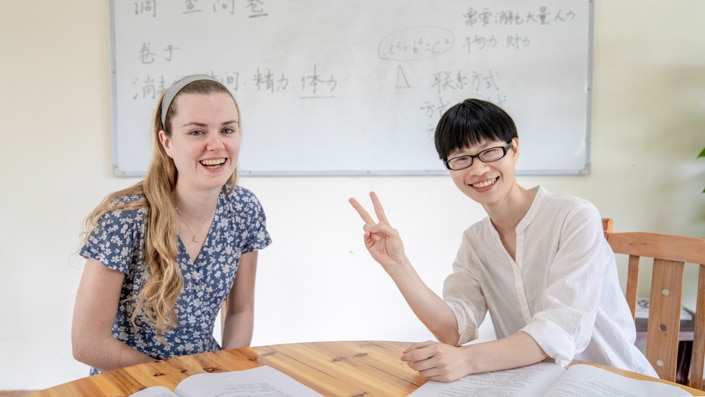
Practicing with your Chinese teacher is a great way to gain a nuanced understanding of the language.
9. 当然 | dāngrán | of course
当然 (dāngrán) is a strongly affirmative expression similar to "of grade" or "certainly" in English. Answering in this way makes yous sound peculiarly confident.
For instance:
| Speaker | 汉字 | Pinyin | English |
|---|---|---|---|
| A: | 你会游泳吗? | Nǐ huì yóuyǒng ma? | Do you know how to swim? |
| B: | 当然。 | Dāngrán. | Yes, of course. |

10. "Yeah" in other situations
1 of the most common ways to say "aye" in Chinese is not a specific give-and-take at all. Rather, it'due south a Chinese grammatical construction that involves expressing agreement by repeating the main verb or adjective in the question asked.
Because responding requires the ability to recognize keywords in a question, this method works best for learners who already accept some bones Chinese vocabulary nether their belts.
This repetition-based method is almost commonly used with verbs. Thus, even if you're a beginner without a large Chinese vocabulary, you'll notwithstanding be able to use this method so long as you've mastered commonly used Chinese verbs like 要 (yào, to want), 有 (yǒu, to accept) and 会 (huì, to be able to).
The following three examples testify these mutual Chinese verbs in action:
| Speaker | 汉字 | Pinyin | English |
|---|---|---|---|
| A: | 你要吃火锅吗? | Nǐ yào chī huǒguō ma? | Do you want to eat hotpot? |
| B: | 要! | Yào! | Aye! |
| Speaker | 汉字 | Pinyin | English language |
|---|---|---|---|
| A: | 这里有人吗? | Zhè li yǒu rén ma? | Is in that location someone sitting here? |
| B: | 有。 | Yǒu. | Yes. |
| Speaker | 汉字 | Pinyin | English |
|---|---|---|---|
| A: | 你会开车吗? | Nǐ huì kāichē ma? | Can you bulldoze? |
| B: | 会。 | Huì. | Yes, I tin can. |
This grammer-based method for proverb "yes" also works with adjectives. In the following example, the adjective 好看 (hǎokàn, good-looking) appears in the question and is and so repeated in the answer resulting in an affirmative response:
| Speaker | 汉字` | Pinyin | English |
|---|---|---|---|
| A: | 你觉得好看吗? | Nǐ juédé hǎokàn ma? | Exercise you think this looks adept? |
| B: | 好看。 | Hǎokàn. | Yes, it looks skillful. |

Learning how to say "yes" in context-appropriate ways will assist you avoid being misunderstood.
Simply say "yes!"
Saying "aye" is one of the most important skills that beginning students of the Chinese language should acquire. Nosotros promise that the above explanations and examples will assist you in your quest to respond to questions like a native.
Getting a feel for which form of "yes" to use in any given situation takes time and practice. If yous still feel confused near when to utilize which give-and-take or phrase, we recommend that y'all try watching some Chinese TV shows . Listening carefully to the dialogue between the characters is a corking way to gain insight into which forms of "aye" experience near natural in diverse different contexts.
Now that you know some of the most common ways to say "yep" in Chinese, don't forget to practice and solidify your new knowledge by communicating with native Chinese speakers, either online or in person .
Remember, 熟能生巧 (shúnéngshēngqiǎo, practice makes perfect)!
At present that you know how to say "yeah," why not continue exploring the essentials of everyday communication in Chinese past checking out our commodity on how to say "no" in Chinese or exploring the wonderful world of Chinese measure words?
Essential Vocabulary for Saying Yes in Chinese
| Hànzì | Pīnyīn | Definition |
|---|---|---|
| 是 | shì | to be (verb); yes (in sure contexts) |
| 是的 | shìde | yes, that'southward right/correct |
| 对 | duì | yes, that'south right/right |
| 没错 | méicuò | yes, that's right/correct/true |
| 好 | hǎo | OK; fine |
| 好的 | hǎo de | OK; will exercise |
| 好呀 | hǎo ya | OK! (sounds excited/enthusiastic) |
| 好吧 | hǎo ba | OK (sounds reluctant) |
| 好了 | hǎole | yeah! (positive); OK, OK (sounds exasperated) |
| 可以 | kěyǐ | yep, you can |
| 行 | xíng | OK; all right |
| 嗯 | èn | uh-huh; aye |
| 没问题 | méiwèntí | no problem |
| 当然 | dāngrán | of course; certainly |
| 要 | yào | to want (verb); yes (in certain contexts) |
| 有 | yǒu | to have (verb); yes (in sure contexts) |
| 会 | huì | to exist able to (verb); yes (in sure contexts) |
Source: https://studycli.org/learn-chinese/yes-in-chinese/
0 Response to "Yes We Can We See Eachother Again in Spanish"
Post a Comment