Ashes Fall and Im Rising Up Again
| "Ring a Band o' Roses" | |
|---|---|
 Melodies for "Ring a Ring o' Roses", Alice Gomme, 1898.[1] | |
| Nursery rhyme | |
| Published | 1881 |
Sound samples
| |

"Ring a Ring o' Roses", "Ring a Ring o' Rosie", or (in the U.s.a.) "Ring Around the Rosie" is originally an English plant nursery rhyme or folksong and playground singing game. It first appeared in print in 1881, only it is reported that a version was already being sung to the current melody in the 1790s and similar rhymes are known from across Europe. Information technology has a Roud Folk Song Index number of 7925.
The lyrics vary, but a modern estimation based on modern lyrics that related the words to the plague in England became widespread postal service WWII, even though information technology appears to exist a false folk etymology.
Lyrics [edit]
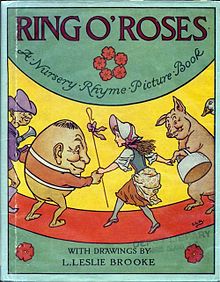
The comprehend of L. Leslie Brooke's Band O' Roses (1922) shows nursery rhyme characters performing the game
It is unknown what the earliest version of the rhyme was or when information technology began. Many incarnations of the game accept a group of children class a ring, dance in a circle around a person, and stoop or curtsy with the final line. The slowest child to practice and so is faced with a punishment or becomes the "rosie" (literally: rose tree, from the French rosier) and takes their identify in the center of the ring.
Variations, corruptions, and vulgarized versions were noted to be in utilize long before the primeval printed publications. I such variation was dated to be in use in Connecticut in the 1840s.[2]
Common British versions include:
Ring-a-ring o' roses,
A pocket full of posies,
A-tishoo! A-tishoo!
We all fall downwards.[3]
Common American versions include:
Band-a-circular the rosie,
A pocket full of posies,
Ashes! Ashes! (*come across note below)
Nosotros all fall down.[3]
- *Some versions replace "Ashes! Ashes!" with "Cerise Bird Blue Bird", or with "Greenish Grass-Yellow Grass".

Some other American version is:
Ring around a' rosies,
Pocket full of posies.
Sugariness staff of life, rye breadstuff,
Squat!.[4]
Common Indian versions include:
Ringa ringa roses,
Pocket total of posies
Husha busha!
We all fall down![5] [vi]
Mutual Māori versions include:
Ring-a-round the roses,
A pocket total of posies,
Kohuru! Kohuru!
We all fall downwards.
The final two lines are sometimes varied to:
Hush! Hush! Hush! Hush!
Nosotros've all tumbled downwardly.[3]
Early on attestation [edit]
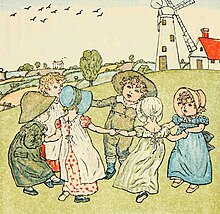
Kate Greenaway's illustration from Mother Goose or the One-time Nursery Rhymes (1881), showing children playing the game
A reference to a young children's game named Band o' Roses occurs in an 1846 article from the Brooklyn Hawkeye. A group of young children (the eldest beingness near seven) grade a ring, from which a boy takes out a girl and kisses her.[7]
An early version of the rhyme occurs in a novel of 1855, The Sometime Homestead past Ann South. Stephens:
A ring – a ring of roses,
Laps full of posies;
Awake – awake!
Now come up and make
A ring – a ring of roses.[8]
The novel goes on to describe a nineteenth-century Fourth of July celebration past children housed in a hospital in Roosevelt Isle, New York (then known as "Blackwell's Island"): "Then the piffling girls began to seek their own amusements. They played 'hide and seek', 'band, ring a rosy', and a g wild and pretty games".[ix]
Another early printing of the rhyme was in Kate Greenaway's 1881 edition of Mother Goose; or, the Old Nursery Rhymes:
Ring-a-ring-a-roses,
A pocket full of posies;
Hush! hush! hush! hush!
We're all tumbled downwardly.[10]
In 1882, Godey's Lady's Volume has the post-obit version:
Band around a rosy
Pocket full of posies.
I, two, three—squat![11]
Before the concluding line, the children stop suddenly, then exclaim information technology together, "suiting the activity to the word with unfailing hilarity and consummate satisfaction".[xi]
In his Games and Songs of American Children (1883), William Wells Newell reports several variants, one of which he provides with a melody and dates to New Bedford, Massachusetts around 1790:
Ring a ring a Rosie,
A canteen full of posie,
All the girls in our town
Ring for little Josie.[two]
Newell writes that "[a]t the end of the words the children of a sudden stoop, and the terminal to get down undergoes some penalty, or has to take the identify of the child in the heart, who represents the 'rosie' (rose-tree; French, rosier)."[2]
An 1883 collection of Shropshire folk-lore includes the post-obit version:
A ring, a band o' roses,
A pocket-full o' posies;
I for Jack and one for Jim and ane for footling Moses!
A-tisha! a-tisha! a-tisha![12]
On the terminal line "they stand and imitate sneezing".[12]
A manuscript of rhymes collected in Lancashire at the aforementioned period gives three closely related versions, with the now familiar sneezing, for instance:
A ring, a ring o' roses,
A pocket full o' posies –
Atishoo atishoo nosotros all fall downwards.[thirteen]
In 1892, folklorist Alice Gomme could give twelve versions.[fourteen]
European variants [edit]

A German language rhyme first printed in 1796 closely resembles "Ring a ring o' roses" in its offset stanza[15] and accompanies the same actions (with sitting rather than falling equally the concluding activeness):[sixteen]
Ringel ringel reihen,
Wir sind der Kinder dreien,
Sitzen unter'm Hollerbusch
Und machen alle Husch husch husch!
Loosely translated this says: "Round about in rings / Nosotros children iii/ Sit below an elderbush / And 'Shoo, shoo, shoo' go we!" The rhyme (equally in the pop collection Des Knaben Wunderhorn) is well known in Germany and has many local variants.[17]
Another German version runs:
Ringel, Ringel, Rosen,
Schöne Aprikosen,
Veilchen blau, Vergissmeinnicht,
Alle Kinder setzen sich! [18]
- In translation: "A ring, a band o' roses,/ Lovely apricots,/ Violets blueish, forget-me-nots,/ Sit down downwards, children all!"
Swiss versions take the children dancing circular a rosebush.[xix] Other European singing games with a potent resemblance include "Roze, roze, meie" ("Rose, rose, May") from The Netherlands with a like tune to "Band a ring o' roses"[20] and "Gira, gira rosa" ("Circumvolve, circle, rose"), recorded in Venice in 1874, in which girls danced around the girl in the middle who skipped and curtsied as demanded past the verses and at the finish kissed the 1 she liked best, so choosing her for the heart.[21]
Meaning [edit]
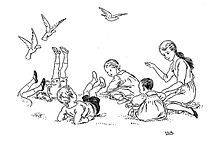
Illustration by L. Leslie Brooke (1862–1940) for "All Tumble Downwardly" from Betimes, Ring O' Roses (1922)
The origins and meanings of the game have long been unknown and bailiwick to speculation. Sociology scholars, even so, regard the Dandy Plague explanation, that has been the near common since the mid-20th century, every bit baseless.
Theories from the belatedly 19th century [edit]
In 1898, A Dictionary of British Folklore contained the belief that an caption of the game was of heathen origin, based on the Sheffield Glossary comparison of Jacob Grimm'southward Deutsche Mythologie. The theory states that it is in reference to Pagan myths and cited a passage which states, "Gifted children of fortune accept the ability to laugh roses, as Freyja wept gilt." It claimed the outset instance to be indicative of pagan beings of light. Another suggestion is more than literal, that it was making a "ring" effectually the roses and bowing with the "all fall down" as a curtsy.[22] In 1892, the American writer, Eugene Field wrote a poem titled Teeny-Weeny that specifically referred to fay folk playing ring-a-rosie.[23]
Co-ordinate to Games and Songs of American Children, published in 1883, the "rosie" was a reference to the French word for rose tree and the children would dance and stoop to the person in the center.[ii] Variations, specially more literal ones, were identified and noted with the literal falling downward that would sever the connections to the game-rhyme. Once more in 1898, sneezing was then noted to be indicative of many superstitious and supernatural behavior across differing cultures.[22]
The Bang-up Plague caption of the mid-20th century [edit]
Since after the 2d World War, the rhyme has often been associated with the Not bad Plague which happened in England in 1665, or with before outbreaks of the Blackness Death in England. Interpreters of the rhyme before World War Ii make no mention of this;[24] past 1951, yet, it seems to take go well established equally an caption for the grade of the rhyme that had become standard in the United kingdom of great britain and northern ireland. Peter and Iona Opie, the leading government on nursery rhymes, remarked:
The invariable sneezing and falling down in modern English versions take given would-be origin finders the opportunity to say that the rhyme dates dorsum to the Great Plague. A rosy rash, they allege, was a symptom of the plague, and posies of herbs were carried as protection and to ward off the smell of the illness. Sneezing or coughing was a final fatal symptom, and "all fall downwards" was exactly what happened.[25] [26]
The line Ashes, Ashes in colonial versions of the rhyme is claimed to refer variously to cremation of the bodies, the burning of victims' houses, or blackening of their skin, and the theory has been adjusted to exist applied to other versions of the rhyme.[27]
In its various forms, the interpretation has entered into pop civilisation and has been used elsewhere to make oblique reference to the plague.[28] In 1949, a parodist composed a version alluding to radiation sickness:
In March 2020, during the early on stages of the COVID-19 pandemic in the United Kingdom, the traditional rhyme was jokingly proposed as the "platonic option" of vocal to accompany manus-washing in club to ward off infection.[30]
Counterarguments [edit]
Sociology scholars regard the Great Plague explanation of the rhyme as baseless for several reasons:
- The plague caption did not appear until the mid-twentieth century.[21]
- The symptoms described do not fit especially well with the Neat Plague.[26] [31]
- The corking variety of forms makes it unlikely that the modern grade is the most ancient one, and the words on which the interpretation are based are not establish in many of the earliest records of the rhyme (see above).[27] [32]
- European and 19th-century versions of the rhyme advise that this "fall" was not a literal falling down, but a curtsy or other form of bending movement that was mutual in other dramatic singing games.[33]
References [edit]
Citations [edit]
- ^ Gomme, The Traditional Games of England, Scotland, and Republic of ireland, p. 108.
- ^ a b c d Newell, William Wells (1884) [1883]. Games and Songs of American Children. New York: Harper & Brothers. pp. 127–128.
- ^ a b c Delamar (2001), pp. 38-9.
- ^ Petersham, Maud and Miska (1945). The Rooster Crows: A Volume of American Rhymes and Jingles. New York: Simon & Schuster, Inc.
- ^ "Ringa Ringa Roses - India". Mama Lisa's World of Children and International Culture . Retrieved 2018-07-18 .
- ^ "Ring a Band a Roses, Ringa Ringa Roses - Poem Lyrics, Rhymes - Parenting Nation India". world wide web.parentingnation.in . Retrieved 2018-07-18 .
- ^ "Gleanings from the Writings of the tardily Wm. B. Marsh IV: Twilight Musings". Brooklyn Eagle. 1846-03-17. p. two.
- ^ Stephens, Ann S. (1855). The Onetime Homestead. London: Sampson, Depression, Son & Co. p. 213.
- ^ Stephens, op. cit, pp. 215–216
- ^ Greenaway, Kate (illustr.) (n.d.) [1881]. Mother Goose, or the Erstwhile Plant nursery Rhymes. London: Frederick Warne and Co. p. 52.
- ^ a b "Games". Godey'southward Lady's Book and Magazine. Philadelphia. cv (628): 379. October 1882.
- ^ a b Burne, Charlotte Sophia (ed.) (1883). Shropshire Folk-Lore. London: Trübner & Co. pp. 511–512. hdl:2027/mdp.39015012258318.
- ^ Opie and Opie (1985), p. 222.
- ^ Opie and Opie (1951), p. 364.
- ^ The 1 normally sung co-ordinate to Böhme (1897), p. 438.
- ^ Böhme (1897), p. 438, Opie and Opie (1985), p. 225.
- ^ Böhme (1897), pp. 438–41, Opie and Opie (1985), p. 227. Other rhymes for the same game have some similarity in the first line, eastward.chiliad. "Ringel, ringel, Rosenkranz", less in other lines – run into Böhme (1897), 442–5.
- ^ "Deutsches Kinderlied und Kinderspiel. In Kassel aus Kindermund in Wort und Weise gesammelt von Johann Lewalter" (Kassel 1911), I Nr. 12. Hermann Dunger, "Kinderlieder und Kinderspiele aus dem Vogtlande" (Plauen 1874), p. 320. Böhme (1897)
- ^ Böhme (1897), p. 439, Opie and Opie (1985), p. 225.
- ^ Opie and Opie (1985), p. 227.
- ^ a b Opie and Opie (1985), p. 224.
- ^ a b Gomme, George Laurence (1898). A Dictionary of British Sociology. D. Nutt. pp. 110–111.
- ^ "Children's Column". The Osage Metropolis Gratis Press. The Osage City Gratis Press (Osage Metropolis, Kansas). 25 August 1892. p. 6. Retrieved 31 July 2015.
- ^ Opie and Opie (1985), pp. 221–222.
- ^ Opie and Opie (1951), p. 365.
- ^ a b Compare Opie and Opie (1985), p. 221, where they note that neither cure nor symptoms (except for death) feature prominently in contemporary or near contemporary accounts of the plague.
- ^ a b Mikkelson, Barbara; Mikkelson, David P. (2007-07-12). "Ring Around the Rosie". Urban Legends Reference Pages. Snopes. Retrieved 2007-01-ten .
- ^ Opie and Opie (1985), p. 221, citing the apply of the rhyme to headline an article on the plague village of Eyam in the Radio Times, 7 June 1973; title of "Ashes" in the New Scientist review.
- ^ "Christmas competition results – Nursery rhyme". The Observer. nine Jan 1949. p. 6. ; quoted in Opie and Opie (1951), p. 365.
- ^ "Messages – Viral news". Individual Center. No. 1518. 20 March 2020. p. 21.
- ^ J. Simpson and S. Roud, A Dictionary of English Sociology (Oxford: Oxford University Printing, 2000), p. 296.
- ^ Opie and Opie (1985), pp. 222–223: "The post-obit are the seven earliest reports known from in Britain ... In only 4 of these recordings is sneezing a feature". The point becomes stronger when American versions are as well taken into business relationship.
- ^ See above, and Opie and Opie (1951), p. 365, citing Chants Populaire du Languedoc: "Branle, calandre, La Fille d'Alexandre, La pêche bien mûre, Le rosier tout fleuri, Coucou toupi – En disant 'coucou toupi', tous les enfants quie forment la ronde, s'accroupissent", roughly translated: "The peach well ripe, the rose all blooming, cuckoo humming – When 'cuckoo humming' is said, all the children forming the circumvolve crouch down".
Full general sources [edit]
- Böhme, Franz Magnus (1897). Deutsches Kinderlied und Kinderspiel. Leipzig: Breitkopf & Härtel. pp. 438–445.
- Delamar, Gloria T. (2001) [1987]. Mother Goose, From Plant nursery to Literature. Lincoln, Nebraska. pp. 38–39. ISBN978-0595185771.
- Gomme, Alice Bertha (1898). The Traditional Games of England, Scotland, and Ireland. Vol. two. London: David Nutt. p. 108.
- Opie, Iona; Opie, Peter (1997) [1951]. The Oxford Dictionary of Nursery Rhymes (2d ed.). Oxford: Oxford University Press (Nabu Printing). pp. 364–365. ISBN978-0198600886.
- Opie, Iona; Opie, Peter (1985). The Singing Game . Oxford: Oxford Academy Press. pp. 221–225, 227. ISBN978-0198600886.
- Simpson, Jacqueline; Roud, Steve (2000). A Dictionary of English language Folklore . Oxford: Oxford University Press. p. 296. ISBN019210019X.
Source: https://en.wikipedia.org/wiki/Ring_a_Ring_o%27_Roses
0 Response to "Ashes Fall and Im Rising Up Again"
Post a Comment